Thursday, October 30, 2008

American Nobel Laureates in science endorse Democratic Senator Barack Obama


Environmental News Service

WASHINGTON, DC, October 29, 2008 (ENS) - In an open letter to the American people released Tuesday, 76 American Nobel Laureates in science endorsed Democratic Senator Barack Obama of Illinois for president of the United States. This is the largest number of Nobel prize winners ever to endorse a candidate for office.

"This year's presidential election is among the most significant in our nation's history," the Nobel Laureates wrote. "The country urgently needs a visionary leader who can ensure the future of our traditional strengths in science and technology and who can harness those strengths to address many of our greatest problems: energy, disease, climate change, security, and economic competitiveness."

"We are convinced that Senator Barack Obama is such a leader, and we urge you to join us in supporting him."

The scientists warned that an administration headed by Obama's opponent Republican Senator John McCain of Arizona would not be good for future U.S. scientific endeavors that over the past eight years "have been damaged by stagnant or declining federal support."

"John McCain's promise to freeze funding increases for science next year threatens to continue this dangerous trend," wrote the Nobel Laureates in chemistry, medicine and physics.
Presidential candidate Senator John McCain, October 28, 2008 (Photo credit unknown)

"In addition, the reckless statements he and Governor [Sarah] Palin [of Alaska] have made on specific science programs including studies aimed at protecting the grizzly bear population, funding for a planetarium and research on fruit flies that have the potential to decimate crops brings to doubt their ability to manage the nation's science programs," the scientists wrote.

The Nobel Laureates were critical of President George W. Bush. Their letter warns, "The government's scientific advisory process has been distorted by political considerations," the scientists wrote. "As a result, our once dominant position in the scientific world has been shaken and our prosperity has been placed at risk."

More on this

Wednesday, October 29, 2008

Oregon's Jeff Merkley: Let's Send A True Blue Democrat To The Senate!

This showed up in my mailbox today, from the Republican party. There is no mention of Senator Gordon Smith's approval of the message, but I'm sure he is aware of it. The message, or should I just call it a psy-op, is pretty clear and the motivation is fear. Problem is that like a lot of things done by the current corporation that calls itself a government, it is directed at the opponent when it is the perpetrator who is to be feared.

Senator Smith was a Ranger, indicating a donation of $200,000 dollars to the George Duhhbya Bu$h campaign. He was also involved in the Abramoff scandle and the "Healthy Forests Iniative", among other things. Ranger Smith collected a cool million $ when Bu$h came to Oregon to show us how to clear the kindling out of our forests.


by Turkana

Most of the Senate seats we flipped two years ago, and most we can flip this year, were and are of the red to purple variety. Electing true blue Democrats just isn't easy. But we can do it, in Oregon. The most recent polls show Jeff Merkley pulling ahead.

Are you ready for another true blue U.S. Senator? Please donate to and/or volunteer for Jeff Merkley!

How great is Jeff Merkley?

Jeff Merkley opposed the boondoggle Wall Street Bailout.

As did Barack Obama, Jeff Merkley opposed the Iraq War before it started. He was also the first U.S. Senate candidate to sign on to "A Responsible Plan to End the War in Iraq”.

Jeff Merkley supports an 80% reduction in greenhouse gasses and massive investments in r & d of renewable energy and other green technologies.

Jeff Merkley believes we must provide universal health care.

Jeff Merkley wants to fully fund Head Start and public schools, and overhaul No Child Left Behind.

Jeff Merkley supports a comprehensive plan to honor and serve our veterans.

Jeff Merkley believes in free trade, but also believes we must reform trade agreements to add labor and environmental standards, stop offshore tax shelters, and prevent fast track.

Jeff Merkley supports marriage equality, led the fight in Oregon's legislature to legalize domestic partnerships, and will oppose effort to pass federal legislation that bans marriage equality.


Tuesday, October 28, 2008

Barack Obama's Speech in Chester, PA | Oct 28 2008

Barack Obama's Speech in Chester, PA | Oct 28 2008


demconwatchblog.com

We can't afford four more years of the tired, old theory that says we should give more to billionaires and big corporations and hope that prosperity trickles down to everyone else. That's the failed theory that got us into this mess.


In the end, the choice in this election isn’t between tax cuts and no tax cuts. It’s about whether you believe we should only reward wealth, or whether we should also reward the work and workers who create it. It’s about whether you believe in an America where opportunity and success is open to anyone who’s willing to work for it. And that’s the America we will build together when I’m President of the United States.

We’ve tried it John McCain’s way. We’ve tried it George Bush’s way. Deep down, Senator McCain knows that, which is why his campaign said that “if we keep talking about the economy, we’re going to lose.” That’s why he’s spending these last weeks calling me every name in the book. Because that’s how you play the game in Washington. If you can’t beat your opponent’s ideas, you distort those ideas and maybe make some up. If you don’t have a record to run on, then you paint your opponent as someone people should run away from. You make a big election about small things.

Pennsylvania, we are here to say “Not this time. Not this year. Not when so much is at stake.” Senator McCain might be worried about losing an election, but I’m worried about Americans who are losing their homes, and their jobs, and their life savings. I can take one more week of John McCain’s attacks, but this country can’t take four more years of the same old politics and the same failed policies. It’s time for something new.

The question in this election is not “Are you better off than you were four years ago?” We know the answer to that. The real question is, “Will this country be better off four years from now?”

More video on Obama's speech in the rain. A message of "Power to the People", and meaningful change.

Oh btw, Half-Hour Obama Infomercial to Air on 7 Networks tonight

~~~~~~~~~~~~~~~~~~~~~~~~~~~~~~~~~~~~~~~~~~~~~~~~~~~~~~~~~~~~~~~~~~~~~~~

Update on Obama Infomercial:


My opinion? Way too goodie two shoe. I felt like I was reading a magazine in the doctors office. Yesterday's rainstorm speech, however, was moving and genuine. Too bad that one wasn't shown on the main stream media.

No news is good news & other non news


click pic to enlarge

Why spread this picture all over the main stream media? This mixed up kid has a Myspace spot and the authorities know where both of the guys involved are. Seems to me that it would be best to keep them under surveillance. Check this kid out. He's wearing lipstick, has effeminate hands, and doesn't know how to hold a gun. The swastika could be a tattoo, but more likely done with felt tip pen. Looks to me like he has a bad case of identity crisis and should seek psychiatric help asap, but if you want to spend some time on Myspace I'm sure you could find plenty of weirdo's with similar stories...G:

Saturday, October 25, 2008

Faux News Hannity& Neocon Bolton: Now it begins

Joe Biden delivers an ominous message about Barack Obama


So what is Biden doing talking about that would ordinarily be top secret stuff? Well, it isn't only him of course, but is probably coming directly from Bu$hco, and the Neocorporate Republic. Colin Powell mentioned a similar thing on Meet The Press Oct. 19th. and UN Ambassador John Bolton re-enforced Bidens warning. Is it just me or does this smell like the NWO?

CNS News

MSNBC 'Meet the Press'


statement at 2:40 into video...G:

Friday, October 24, 2008

Detour their's a muddy road ahead.....zzzzzZZZZ


Stocks head for sharp decline on recession fears

By STEVENSON JACOBS – 36 minutes ago

NEW YORK (AP) — Wall Street headed for another precipitous drop Friday as fears of a punishing global recession stirred panic among investors and sent world financial markets into a tailspin. The Dow Jones industrial average futures fell 550 points, triggering a halt in selling of stock future contracts.


The massive decline was caused by increasingly grim news from overseas. In Japan, shares of Sony sank more than 14 percent after it slashed its earnings forecast for the fiscal year. In Germany, Daimler's stock dropped 11.4 percent in morning trading after it reported lower third-quarter earnings and abandoned its 2008 profit and revenue guidance.

Japan's Nikkei stock average fell a staggering 9.60 percent. In Europe, Germany's benchmark DAX index was down 10.76 percent, France's CAC40 dropped 10 percent while Britain's FTSE 100 sank 8.67 percent after the government said its gross domestic product fell 0.5 percent in the third quarter, putting the country on the brink of recession.

The dour outlook convinced investors that the world economy is headed for a long and severe downturn despite a raft of government rescue efforts aimed at pulling the financial system from the brink. It also indicated that the tremors caused by the global credit crisis may have only begun to be felt in their true scope and magnitude.

"There's a lot of panic out there today," said Scott Fullman, director of derivatives investment strategy for WJB Capital Group in New York. "People have been saying that we're in a recession. This is the realization."

Fearing more carnage in world equity markets, big hedge funds and other institutional investors have been pulling out their money en masse in a bid to reduce risk and raise cash — a process known as deleveraging that only intensifies the selling. Meanwhile, individual investors that have seen their holdings decimated in recent weeks have been yanking money out of mutual funds, adding to the downward pressure on markets.

"I think it would be natural to make an assumption that there are some funds in trouble and that we may see some funds shut down," Fullman said.

Ahead of the market's open, Dow Jones industrial average futures fell the maximum allowed limit of 550, or 6.27 percent, to 8,224. That triggered "circuit breakers" that automatically freeze selling until the market's 9:30 a.m. EDT open. However, traders can still buy stocks and send the market higher.

The Standard & Poor's 500 index futures index was also down the maximum allowed 60 points, or 6.56 percent, to 855.20, and the Nasdaq 100 index futures was down the maximum allowed 85.00, or 6.20 percent, at 1,175.75.

Thursday, October 23, 2008

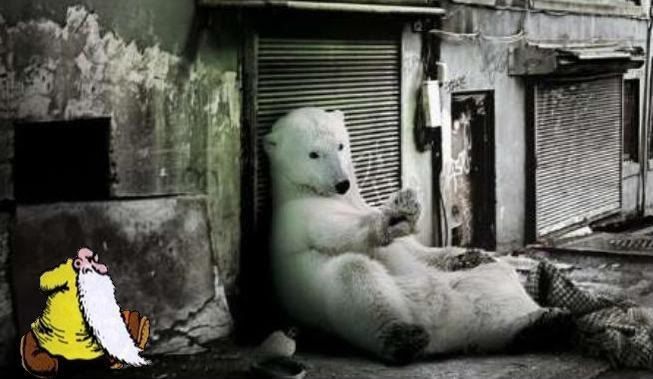
Our country is like Jack the bear, making tracks and getting nowhere

Example

Well folks, while it's true that we are in deep doodoo over the global financial crisis, there are folks on the street who have no where to go and no money for food. I doubt that they will be concerned about the stock market or the banks going under, as much as our representatives in the corporate government are, and the election of a new president is probably nothing but a humorless joke.

Jack the bear is making tracks and going nowhere, but won't have any heating problems like the street folks. It's all about being cool to him and finding a place to hang out for his winter siesta. One thing for sure, he's pretty light on the planet and, out of necessity, there are many folks who are not far behind him.


See full PBS Frontline video ~HEAT~

The world needs to dramatically cut the carbon emissions responsible for wreaking havoc on the planet's climate, according to Dr. Rajendra Pachauri, whose organization, the Intergovernmental Panel on Climate Change (IPCC), shared last year's Nobel Peace Prize. "If we don't take action immediately, we face a crisis," Pachauri tells Smith. "Climate change is caused by human actions, and we need to do something about it. The sooner we realize that, the better."

With that sense of urgency in mind, Smith traveled to 12 countries on four continents to investigate whether major corporations and governments are up to the challenge. HEAT features in-depth interviews with top policy-makers and with leading executives from many of the largest carbon emitters from around the world, including Chinese coal companies, Indian SUV makers and American oil giants. The report paints an ominous portrait. Despite increasing talk about "going green," across the planet, environmental concerns are still taking a back seat to shorter-term economic interests.

Tuesday, October 21, 2008

Sarah Palin, McCain, Colin Powell, & the Bush Doctrine


Colin Powell Decimates McCain's Rationale


The Bush Doctrine Explained

Chronology: The Evolution of the Bush Doctrine

Feb. 28, 1991

A war with Iraq to oust Saddam Hussein would be the first test case in the Bush administration's larger strategy for projecting U.S. power and influence in the post-Cold War world. Here's an overview of the people, the events, the major statements, and the policy battles behind what's become known as the Bush Doctrine.

The Gulf War's Ragged Ending; U.S. Decides on Containment Policy for Iraq

With a Gulf War cease fire declared, President Bush, Defense Secretary Dick Cheney and Chairman of the Joint Chiefs of Staff Colin Powell believe Saddam's hold on Iraq is tenuous. Bush urges Iraqis to rise up. They do, and within days Saddam has lost control of southern Iraq. But the rebellion is soon overwhelmed by Saddam's forces, which include helicopter gunships, and Bush orders U.S. troops not to intervene. It is estimated that thousands of Shiites were killed.

The failed uprising is a defining moment for neo-conservatives such as Richard Perle, William Kristol, and Paul Wolfowitz. Wolfowitz complains that the U.S. inaction is comparable to "idly watching a mugging."

With Saddam clinging to power, Bush decides on a containment strategy towards Iraq: tough U.N. inspections, economic sanctions, and no-fly zones to protect the Kurds in the north and south of the country.

The War Behind Closed Doors


PBS: FRONTLINE

published feb. 20, 2003

In the first emergency meeting of the U.S. National Security Council on the day of the attacks, Rumsfeld asked, "Why shouldn’t we go against Iraq, not just al-Qaeda?" with Wolfowitz adding that Iraq was a "brittle, oppressive regime that might break easily—it was doable," and, according to John Kampfner, "from that moment on, he and Wolfowitz used every available opportunity to press the case." The idea was initially rejected, at the behest of U.S. Secretary of State Colin Powell, but, according to Kampfner, "Undeterred Rumsfeld and Wolfowitz held secret meetings about opening up a second front—against Saddam. Powell was excluded." In such meetings they created a policy that would later be dubbed the Bush Doctrine, centering on "pre-emption", American unilateralism, and the war on Iraq, which the PNAC had advocated in their earlier letters

Frontline Video

Saturday, October 18, 2008

Michelle Bachman R Minn revives McCarthyism


McCarthyism

Joseph Raymond McCarthy (November 14, 1908 – May 2, 1957) was an American politician who served as a Republican U.S. Senator from the state of Wisconsin from 1947 until his death in 1957. Beginning in 1950, McCarthy became the most visible public face of a period of intense anti-communist suspicion inspired by the tensions of the Cold War. He was noted for making claims that there were large numbers of Communists and Soviet spies and sympathizers inside the federal government and elsewhere. Ultimately, McCarthy's tactics and his inability to substantiate his claims led to his being discredited and censured by the United States Senate. The term "McCarthyism," coined in 1950 in reference to McCarthy's practices, was soon applied to similar anti-communist pursuits. Today the term is used more generally to describe demagogic, reckless, and unsubstantiated accusations, as well as public attacks on the character or patriotism of political opponents.

Salon

The Palins' un-American activities

Imagine if the Obamas had hooked up with a violently anti-American group in league with the government of Iran.

By David Talbot

Oct. 7, 2008 | "My government is my worst enemy. I'm going to fight them with any means at hand."

This was former revolutionary terrorist Bill Ayers back in his old Weather Underground days, right? Imagine what Sarah Palin is going to do with this incendiary quote as she tears into Barack Obama this week.

Only one problem. The quote is from Joe Vogler, the raging anti-American who founded the Alaska Independence Party. Inconveniently for Palin, that's the very same secessionist party that her husband, Todd, belonged to for seven years and that she sent a shout-out to as Alaska governor earlier this year. ("Keep up the good work," Palin told AIP members. "And God bless you.")

AIP chairwoman Lynette Clark told me recently that Sarah Palin is her kind of gal. "She's Alaskan to the bone ... she sounds just like Joe Vogler."

So who are these America-haters that the Palins are pallin' around with?

Before his strange murder in 1993, party founder Vogler preached armed insurrection against the United States of America. Vogler, who always carried a Magnum with him, was fond of saying, "When the [federal] bureaucrats come after me, I suggest they wear red coats. They make better targets. In the federal government are the biggest liars in the United States, and I hate them with a passion. They think they own [Alaska]. There comes a time when people will choose to die with honor rather than live with dishonor. That time may be coming here. Our goal is ultimate independence by peaceful means under a minimal government fully responsive to the people. I hope we don't have to take human life, but if they go on tramping on our property rights, look out, we're ready to die."

Friday, October 17, 2008

Winds of change clear the air in NY


Obama, McCain share laughs at dinner

The Swamp

Barack Obama reveals that his middle name actually is 'Steve.'

Posted October 17, 2008 7:52 AM

NEW YORK -- Barack Obama and John McCain appeared together last night at the Alfred E. Smith Memorial Foundation Dinner. The entertaining pool report here comes from the New York Times' Jeff Zeleny:

Sen. Barack Obama was preceded - actually, introduced - at the Alfred E. Smith Memorial Foundation Dinner by Sen. John McCain, who took the first turn at the lectern. He delivered many lines that left Mr. Obama laughing out loud.

"I can't shake that feeling that some people here are pulling for me," Mr. McCain said, turning to the far side of the stage. "I'm delighted to see you here tonight, Hillary."

Mr. McCain assured those in the ballroom that his rival was not fazed by being called, "That one," during the second presidential debate.

"He doesn't mind at all, in fact, he even has a pet name for me: George Bush," Mr. McCain said.

Mr. McCain offered several words of praise, which Mr. Obama acknowledged with applause and a nod of the head.

"My opponent is an impressive fellow in many ways. Political opponents can have a little trouble seeing the best in each other. I have seen this man at his best. I admire his great skill, energy and determination," Mr. McCain said. "It's not for nothing that he has inspired so many folks in his own party and beyond. Senator Obama talks about making history and he's made quite a bit of it already.

"There was a time when the mere invitation of an African American citizen to dine at the White House was taken as an outrage and an insult in many quarters. Today, it's world away from the cruel and frightful bigotry of that time. And good riddance.

"I can't wish my opponent luck, but I do wish him well."

After a handshake, Mr. Obama took the lectern for his turn.

"I was originally told the venue would be Yankee Stadium. Can somebody tell me what happened to the Greek columns that I requested?" Mr. Obama said.

Later, he added: "I do love the Waldorf Astoria. I hear from the doorstep you can see all the way to the Russian Tea Room."

(Yes, Mr. McCain laughed. A lot.)

Mr. Obama, noting his age, said he did not have the pleasure of knowing Al Smith, but added: "From everything Senator McCain has told me, he was a great man."

Then, he gave a shout out to Mayor Bloomberg.

"The mayor recently announced some news that he would be rewriting the rules and have a third term, which prompted Bill Clinton to say: You can do that?" Mr. Obama said.

As Mrs. Clinton laughed on stage, Mr. Obama added: "I'm glad to see you made it Hillary. I hear Chuck Schumer tried to tell you that we really did move this event to Yankee Stadium."

Mr. Obama continued with Mrs. Clinton, saying: "She's the primary reason I have all this gray in my hair now."

~more~

Thursday, October 16, 2008

I did not have sex with that plumber


Say It Isn’t So, Joe!

Wurzelbacher Not A Real $250K Plumber?

Steve Young

October 16, 2008

Joe The Plumber, aka Joe Wurzelbacher, the Toledo plumber who became the hot topic of the last Presidential debate due to his rope-line confrontation with Barack Obama’s over the Democratic candidate’s tax plan, may not be a plumber, and may not be planning to buy a plumbing business where he will be netting $250,000 a year.

He isn’t in the Toledo Yellow Pages, he isn’t registered to vote and it’s more likely that his existence as a plumber buying a $250K business is as sincere as Sarah Palin asking Joe Biden if she can call him “Joe.”

Isn’t it interesting that Joe is buying a business that is making a profit of exactly $250K, the Obama tax break minimum. A normal business acquisition falls into the 4 to 1 investment area, which would call for Joe to come up with $1,000,000 to purchase his $250K business. If that plumbing business had assets like trucks, equipment and offices, the cost could be far more.

Red State Update With Joe The Plumber

Wednesday, October 15, 2008

US nationalizes banks, candidates talk economy


the Real News network

October 15, 2008

Mike Whitney: Both candidates promote stimulus but real solution is higher wages

US President George W Bush made the radical announcement on Tuesday of the partial nationalization of the 9 of the nations leading banks. The move to part ownership by the government, was made to ensure that the banks won't be hoarding their bailout money, but use it to bolster lending -- to each other and to customers. The Presidential candidates also announced their economic proposals to deal with the current financial meltdown.

The current Neocorporate Cabal occupying the White House has been running things from the top down for almost eight years, and has pretty much confirmed that my opinion of a "George Duhbya Bu$h" presidency would be one of war and wasteful spending.

The idea of
feeding the monster that has contributed to war, greed, and untold debt on the people of America makes me want to spit nails. The banking industry is the single most profitable business on the planet, and the Federal Reserve consists of the wealthy elite who are supposed to be the economical guru's of finance. So Duhhbya himself has decided to front them hundreds of billions of dollars to lift us out of the mud, while "we the people" lose our jobs and homes. Arrgh* isn't it about time to start working from the bottom up? ...G:

Monday, October 13, 2008

Did anybody see all this coming?


Our resident financial expert calls the end of the housing-market free fall—to the day.

On June 30, 2009, Buy an Apartment

NY Magazine

By James J. Cramer
Published Sep 7, 2008

For more than a year, I’ve been a huge bear on housing. From the moment the credit-crisis storm began to form, I’ve been shouting in my usual unhinged way about just how bad the devastation would be, and carrying on about how anyone who bought a home in this environment would lose money immediately. At various points along the way, my house-hating judgment has been questioned, but I’d say I’ve been vindicated by the relentless decline in home values we’ve seen, the worst since the Great Depression. Even here, in our so-called real-estate-superstar city, prices may not have fallen, but the rate of acceleration has started to soften.

These days, I don’t know a soul who hasn’t jumped on the real-estate-is-an-awful-investment bandwagon. When I interview the once-rabid bulls on housing—those who make their livelihood building and selling homes, like Bob Toll, the CEO of the best home builder in America, Toll Brothers—I get grim predictions of nary a turn in sight. When I pressed Toll recently as to whether he sees any light at the end of the tunnel, he quickly answered yes: “The light of an oncoming train!”

How much do you know about playing the stock market with options?

Ron Paul on Mad Money w/ Jim Cramer 12-14-07

Fat cats profit from Volatility in hedge fund markets


Riding the cycle

Jan 10th 2008
From The Economist print edition
Why volatility will never go away

CAN it only be a year ago that volatility was so low in the financial markets? Traders must have found their lives awfully dull, without so much as a currency crisis to get the pulse racing.

Some began to argue that volatility had moved to a structurally lower level thanks to the activity of hedge funds and to the development of complex products and derivatives. A new, more sophisticated financial system had spread risk more efficiently, it was said.

But over the past 12 months, the standard measure of stockmarket volatility, the Vix (or volatility index), has roughly doubled. On top of that, there have been wild swings in government bond yields, a jump in debt spreads and the continuing decline of the dollar.

To grasp one reason why volatility has surged, you need to understand how the Vix is calculated. The measure is derived from the world of options, the instruments that allow investors to protect themselves against (or speculate on) future price movements. A call option, for example, gives the holder the right to buy an asset at a specified price within a specified period.

Say there are two shares, each trading at $80; one is a young technology company, the other a staid power generator. In each case, there is an option contract offering the chance to buy the shares at $100 at some point within the next three months. Logically, you would expect to have to shell out more for the option to buy the technology company's shares, since it is more likely suddenly to announce some whizzy breakthrough that causes its share price to shoot upwards. In other words, it costs more to purchase options on assets that are likely to be more volatile in price.

When one “reverse engineers” an option price (taking out factors such as the time value of money), the residual factor is known as implied volatility, which could be described as the uncertainty applying to the asset. The Vix represents this figure for the S&P 500 index.

The vast majority of options expire without being exercised; the asset price never moves sufficiently to make it worthwhile. To put this in technical terms, the implied volatility in the option price turns out to be higher than the realised volatility. So there are plenty of people who earn a decent income by selling options; just like insurers, they earn a premium every time they make a sale.

In quiet markets, the number of people who want to sell options increases, driving their prices, and thus the level of implied volatility, down. That was one reason why volatility was so low last year. But when the markets went into a tailspin in August, volatility suddenly surged; it became much more likely that those who had previously bought options would be able to exercise them (particularly put options, which grant the right to sell at a given price). Option-sellers suddenly faced losses; some, realising the risks, probably withdrew from the business. That forced implied volatility even higher.

There is thus a cyclical element to volatility, as investors move from complacency to alarm. That fits in with the work of Hyman Minsky, an economist who suggested that periods of stability may sow the seeds of future volatility. If economic growth and interest rates are stable, businesses and consumers will be encouraged to take more risks, and in particular to take on more debt. Eventually, small changes in interest rates will have a much greater impact on balance sheets and on consumer willingness to spend.

A long-term graph of the Vix hints at cyclicality, with periods of great choppiness in the early and late 1990s book-ending an era of relative calm in the middle of the decade. It is hard to say that any level is “normal”; volatility is in itself volatile.

It may be ever so. Another important factor behind market movements must be the difference in incentives between investing institutions, such as pension funds, and the intermediaries that work on their behalf. Pension funds would like nothing better than for asset markets to rise in a steady, predictable fashion, so it would be easy to work out how to meet their liabilities. But that would not be so great for traders. Steady markets would give investors fewer reasons to deal, and so traders would have less chance to earn the spread between sell and buy prices. And the more volatile markets are, the better the chance that a trader will be on the right side of some big price move, and win himself a fat bonus. So traders are tempted into making big bets, and in doing so also add to volatility.

It is small comfort for the rest of us, but every time the Vix jumps sharply, someone at a hedge fund has just earned himself a nice new yacht.

Friday, October 10, 2008

Duhbya's video finally appears?


Was it just me, or was there something weird going on today at the White House. Around 7:30 am I started a video on whitehouse.gov, but it went off and I couldn't connect. I went back later, and there was a video with voice, but no picture. The first video I could find was on http://www.wral.com/news/national_world/national/video/3712780/.
The MSNBC video that is now playing wasn't there earlier in the day...G:?

Hmm, I just checked whitehouse.gov again and still no picture on the video, and the audio version sounds the same as the video version. It sounds like one of his weekly radio addresses in quality. Just wondering? Another thing that bothers me is that he is standing there by himself in the rose garden during one of his most important moments in history.

Why is that I keep having this dejavu? I feel like I'm watching the reading of "My Pet Goat"..G:

Thank you Bu$hco

We sure gotta thank Duhhbya for iniating another program "Hope Now" for those folks who have a few bucks left after losing their homes due to his "Ownership Society". If it hadn't been for Bu$h's promotion of Fannie May and Freddy Mac they would still be nobodies. Thank you Duhbya and thank gawd for the "Healthy Forests Iniative" that give us all those sticks to build our houses with. Who could be more thankful for "Hope Now" than a homeless carpenter who is also jobless?

We wish you all the best Bu$h , and hope that life will be a little simpler where you're heading. Paraguay is nice this time of year and their's good folks there. Some of them own laptops, while others still use blowguns and live in the jungle...G:

Grass roots for bottoms up economy & Lincoln's warning

I don't know a lot about the stock market,and speak from the viewpoint of a retired small business owner. I quit my regular job in the mid 1980's, and went into the second hand and then antique business with my brother, which is maybe one of the last vestiges of free enterprise. Now what I heard in discussions by members of the global elite was about solving problems from the top down, while in my opinion there are many problems down here on the bottom. The grass roots aren't doing so well these days, what with all of the chemical farming going on and no one hoeing their weeds because they seen an ad on TV & believe that Roundup is God's gift to the suburban lawn. This once great country was built on the concept of free enterprise and anyone could jump in without having to worry about restrictions and rules from every branch of government that quickly stifle any attempts to build something like, say, a more effecient automobile. In the 1910's & 20's there were at least two hundred makes of automobiles and trucks, many of them from small companies: they ran on gas, electricity, kerosene,or steam. If you owned a small farm you could buy a truck to haul your produce to market, of which there were many, or your grain to the family that owned an elevator. It was free enterprise and at that time was built from the bottom up. I'm not saying that its as simple as all this, but do think that this must be considered, and who knows, if this downhill slide continues with no brakes, we may be doing just that...G:

An early Republican viewpoint:

"The prudent, penniless beginner in the world, labors for wages awhile, saves a surplus with which to buy tools or land for himself, then labors on his own account another while, and at length hires another new beginner to help him. This is the just and generous and prosperous system, which opens the way to all, gives hope to all, and consequent energy and progress, and improvement of condition to all. No men living are more worthy to be trusted than those who toil up from poverty--none less inclined to take or touch aught which they have not honestly earned. Let them beware of surrendering a political power which they already possess, and which, if surrendered, will surely be used to close the door of advancement against such as they, and to fix new disabilities and burdens upon them, till all of liberty shall be lost."

Abraham Lincoln

Senior citizens hold their breath as Bu$hco promises more Social Security Benefits


Social Security Benefits To Go Up By Larger-than-Usual Amount

MarketWatch

October 8, 2008 Wednesday 8:22 PM EST

Robert Powell has been a journalist covering personal finance issues for more than 20 years, writing and editing for publications such as The Wall Street Journal, the Financial Times, and Mutual Fund Market News.

BOSTON (MarketWatch) -- Amidst all the volatility and uncertainty in the financial markets these days, one thing is definite: Come October 16, Uncle Sam will announce the cost-of-living adjustment for 34 million Americans who now receive Social Security benefits.

Unlike in years past, however, that adjustment is expected to be among the largest increases in 25 years.

No one yet knows exactly how big the automatic benefit hike will be. But experts are predicting that Social Security beneficiaries will see their monthly benefit rise by at least 5%, perhaps more. In calculating the COLA, Social Security will look at inflation over the 12 months ended September 2008. For the year ended August 2008, inflation as measured by the consumer price index (CPI-W) was running at 5.4%.

That means the average monthly benefit could rise to about $1,137 from $1,079 now, a $58 increase.

What's more, unlike in years past, that increase won't be eaten up entirely by increases in Medicare Part B and Part D premiums, though it will be close. For about 95% of Medicare recipients, Part B premiums will remain at $96.40 in 2009, the Centers for Medicare and Medicaid Services said last month.

Well, I haven't heard good news like this for a long time,except for the fact that McPain is way behind in the polls. If Bu$hco and John McSame get their way there will be an attempt to put some of the social security payments into the stock market so I'll be keeping my ear to the ground untill election day...G:

.......zzzzzzzZZZZZZZ

Markets in America, Asia and Europe in ~~~~~~~~~~freefall~~~~~~~~~~~~


The markets

Off a cliff

The Economist

Oct 10th 2008 | NEW YORK, TOKYO
From Economist.com

Markets in America, Asia and Europe plummet, as fears grow over financial and economic conditions

Shutterstock

MARKETS in Asia and Europe plummeted on Friday October 10th. Japan’s stockmarket ended the week in disarray: the Nikkei 225-share index fell by 24% on the week, twice the weekly fall of the 1987 crash. It is now at five-and-a-half-year lows. Europe followed suit. London’s FTSE 100 slumped by more than 10% within minutes of opening; by mid-morning European stocks were also down, with Germany's DAX index down by more than 8%. Amid widespread anxiety the oil price also tumbled, to around $81 a barrel, its lowest level in a year.

Click here for updated chart

The falls underline that stockmarkets, traumatised by the near-paralysis in credit markets, the collapse of once-mighty banks and the prospect of global recession, are suffering what has been dubbed a “cascading crash”: a series of blows which, added together, are stomach-churning.

Wall Street is unimpressed by the TARP, America’s much-vaunted $700-billion bail-out. The Dow Jones Industrial Average had plunged by 679 points, or 7.3% on Thursday. Nor are markets reassured by a bevy of bank rescues, a co-ordinated rate cut by the world’s leading central banks, the Federal Reserve’s radical decision to buy commercial paper, Britain’s £500 billion ($861 billion) bail-out package, nor the raft of piecemeal rescues by other European governments. On Thursday the International Monetary Fund activated a procedure to offer emergency loans to threatened countries, such as Iceland, which took over its largest bank on Thursday.

In Asia, which had been relatively insulated from recent woes, panic selling set in, as markets slumped in Hong Kong, South Korea and Taiwan, among others. Indonesia's fell by 10.4% on Wednesday before regulators suspended trading. (Equity trading was also suspended in several European exchanges, including those of Russia, Austria and Iceland.

More

Thursday, October 09, 2008

American Homeownership Resurgence Plan


McCain changes homeowner plan

By: Mike Allen
October 9, 2008 12:07 PM EST

Sen. John McCain (R-Ariz.) made an overnight change in the homeowner bailout he proposed at Tuesday’s presidential debate, making it more generous to financial institutions and more costly for taxpayers.

McCain's staff says it was always meant that way.

When McCain sprang his surprise idea at the start of the debate in Nashville, his campaign posted details online of his American Homeownership Resurgence Plan, which would direct the government to buy up bad home mortgages, allowing strapped people to keep their property.

The document posted and e-mailed by the McCain campaign on Tuesday night says at the end of its first full paragraph: Lenders in these cases must recognize the loss that they’ve already suffered.

So the government would buy the mortgages at a discounted rate, reflecting the declining value of the mortgage paper.

But when McCain reissued the document on Wednesday, that sentence was missing, to the dismay of many conservatives.

That would mean the U.S. would pay face value for the troubled documents, which was the main reason Sen. Barack Obama (D-Ill.) gave for opposing the plan.

A McCain campaign official explained the change: “That language was mistakenly included in the initial draft, and it’s been corrected. It doesn’t reflect the intentions of the initiative, which necessitated the correction and the removal of the sentence. A simple mistake.”

Obama Campaign Economic Policy Director Jason Furman said in the campaign statement opposing McCain's plan: "John McCain wants the government to massively overpay for mortgages in a plan that would guarantee taxpayers lose money and put them at risk of losing even more if home values don’t recover. The biggest beneficiaries of this plan will be the same financial institutions that got us into this mess, some of whom even committed fraud."

The McCain campaign estimates in both documents that the plan would cost about $300 billion.

Original article on POLITICO

Wednesday, October 08, 2008

9/11 and the "American Inquisition"


by Michel Chossudovsky

Global Research, September 11, 2008

Today's "Global War on Terrorism" is a modern form of inquisition. It has all the essential ingredients of the French and Spanish inquisitions.

Going after " Islamic terrorists", carrying out a Worldwide preemptive war to " protect the Homeland" are used to justify a military agenda.

"The Global War on Terrorism" (GWOT) is presented as a "Clash of Civilizations", a war between competing values and religions, when in reality it is an outright war of conquest, guided by strategic and economic objectives.

The GWOT is the ideological backbone of the American Empire. It defines US military doctrine, including the preemptive use of nuclear weapons against the "state sponsors" of terrorism.

The preemptive "defensive war" doctrine and the "war on terrorism" against Al Qaeda constitute essential building blocks of America's National Security Strategy as formulated in early 2002. The objective is to present "preemptive military action" --meaning war as an act of "self-defense" against two categories of enemies, "rogue States" and "Islamic terrorists", both of which are said to possess weapons of mass destruction.

The logic of the "outside enemy" and the evildoer, allegedly responsible for American civilian deaths, prevails over common sense. In the inner consciousness of Americans, the attacks of September 11, 2001 justify acts of war and conquest:

"As was demonstrated by the losses on September 11, 2001, mass civilian casualties is the specific objective of terrorists and these losses would be exponentially more severe if terrorists acquired and used weapons of mass destruction." (National Security Strategy, White House, Washington, 2002)

Full Article

TERROR

This definition of terror is from Funk & Wagnalls dictionary ca.1893 which makes a whole lot more sense to me than the current one used by George Duhhbya Bu$h & Co. Somehow the whole idea of declaring a war on terrorism has escaped me, just like a war on fascism or any other ism would.

My old dictionary has no definition for Fascism, or even Fascist for that matter, so I guess that Wikipedia will do...

Facsism is a totalitarian nationalist and corporatist ideology. It is primarily concerned with notions of cultural and social decline or decadence, and which seeks to achieve a millenarian national rebirth by exalting the nation, as well as promoting cults of unity, strength and purity.

Various scholars attribute different characteristics to fascism, but the following elements are usually seen as its integral parts: nationalism (including national socialism, socialism, national syndicalism, along with collectivism and populism based on the nationalist values); totalitarianism (including dictatorship, major social interventionism, and statism); third way (including class collaboration, the economic ideology of corporatism, economic planning,) and militarism. Fascism opposes communism, conservatism, liberalism, and international socialism.


Olbermann's take on terror

Tuesday, October 07, 2008

Witness To WTC Explosions On 9/11 Kills Himself


Infowars

Steve Watson Friday, Sept 5, 2008

A janitor who worked in one of the World Trade Center towers and helped save lives on 9/11, in addition to witnessing what he described as "explosions" in the tower basement, has committed suicide.

The New York Daily News reported yesterday that Kenny Johannemann shot himself in the head last Sunday, August 31, 2008.

Mr Johannemann's suicide note stated that he was taking his own life as he was being evicted and could not handle homelessness. The note also stated that since 9/11 he had become depressed and had been drinking.

According to the Daily News report, relatives found another letter next to his suicide note. The second letter (right), dated October 31 2001 and type written on White House stationery featuring the president's signature, was an acknowledgement of Johannemann's bravery on 9/11.

The letter refers to Johannemann's actions of pulling a burning survivor to safety, thus saving his life.

In the aftermath of the attacks, Johannemann appeared on the "Jenny Jones Show" to relate this story.


Johannemann's employer at the time, ABM Industries featured him on the front cover of their 2002 magazine which recounted employee accounts of the events of 9/11.

The Daily News article features quotes from a Joseph Maya, described as a cousin of Johannemann. Maya reportedly stated that during this time after 9/11 Johannemann became reclusive and stopped associating with his family, something he had previously "delighted in".

MORE

Monday, October 06, 2008

Robert Parry: America pays the piper, big time Pt 3


Robert Parry is an American investigative journalist. He was awarded the George Polk Award for National Reporting in 1984 for his work with the Associated Press on the Iran-Contra story and uncovered Oliver North's involvement in it as a Washington-based correspondent for Newsweek.In 1995, he established Consortium News as an online ezine dedicated to investigative journalism. From 2000 to 2004, he worked for the financial wire service Bloomberg.
Parry has written several books, including Lost History: Contras, Cocaine, the Press & "Project Truth." (1999) and Secrecy &; Privilege: Rise of the Bush Dynasty from Watergate to Iraq
Major subjects of Parry's articles and reports on Consortium News include the presidency of George W. Bush, the career of Army general and Bush Secretary of State Colin Powell, the October Surprise controversy of the 1980 election, the Nicaraguan contra-cocaine investigation, the efforts to impeach President Clinton, right-wing terrorism in Latin America, the political influence of Sun Myung Moon, mainstream American media imbalance, United States Defense Secretary Robert Gates, as well as international stories.

Robert Parry: America pays the piper, big time Pt 2

Sunday, October 05, 2008

History of laser technology


Stimulated Emission - 1917

The physicist Albert Einstein had described the theory of stimulated emission as early as 1917, but it would still take 30 years before engineers began to utilize this principle for practical purposes. Scientists were amazed by this technical breakthrough but laser technology itself had no real purpose. This is not exceptional, discoveries may need time before being put to use. Today laser is used in communication, industry, medicine, and environmental care and research. Laser has become one of the most powerful tools for scientists in physics, chemistry, biology and medicine throughout the world. One area that is considered to be very interesting is in the different methods to cool and capture atoms by using laser. We don't know yet what this knowledge and technology will be used for in the future, but we do know that future applications will be based on today's research.

Most of us are involved with lasers in one form or the other in our everyday activities. I guess my first involvement was in the 1970's, as a surveyor, when we started using electronic distance measure, a little box that set on top of the transit and sent a laser beam to a prism to measure the distance with accuracy that we couldn't achieve with survey tapes. Not even invar tapes using temperature correction and balance scales could come close. This was the second big technological change for the land surveying trade, the first being the advent of the Hewlet Packard hand held calculator,which made our books of trigonometric functions and logrythems obselete, as well as all of our mechanical number crunchers, including the Curta hand held calculator that gave answers to 8 places and was no larger than a can of soup. I still have mine, and it is now a collectors item, just like the slide rules that the nerds all carried. Even the first electronic calculators are collectable now, with the HP 35 being worth several hundered $, which makes calling me a relic from the past seem like an understatement...G:

Saturday, October 04, 2008

BUSH, BAILOUTS, and BIMBOS

Duhhbya say's there'$ a chance we'll get our money back


Defence + Bailout = $1.3 Trillion Dollars!


Yep, We the Sheeple have been fleeced for $1,312,000,000,000 to prop up the Industrial War Complex and the Corporate Government that pre-emptively and systematically put us into war in the Middle East. Not only did Bu$hco lie, cheat,and steal to do so, but also entrenched Neoconservative operatives in every part of government, education, business, social programs etc. etc. etc. Bu$hco also initiated the Ownership Society and the necessary loan and credit programs to put this in place, such as Fannie Mae and Freddie Mac. Not only that but Bu$hco initiated the Healthy Forest's Initiative to make more lumber available to build the homes that are now being foreclosed on. And, as you and I know, the list of Bu$h crimes would easily fill his proposed Presidential Library.

I don't know about you, but I'm concerned about keeping warm this winter...G:


Bush signs sprawling spending bill

Sept 30, 2008

WASHINGTON (AP) — President Bush on Tuesday signed a sprawling, stopgap spending bill to keep the government running for the next 12 months.

The president's move, which came on the last day of the government's budget year, was expected even though the measure spends more money and contains more pet projects than he would have liked. The legislation is one of the few bills this election year that simply had to pass.

The $630 billion-plus spending bill wraps together a record Pentagon budget with aid for automakers and natural disaster victims, and increased health care funding for veterans returning from Iraq and Afghanistan.

The measure also lifts a quarter-century ban on oil drilling off the Atlantic and Pacific coasts, a victory for Bush and fellow Republicans.

CRISIS ON WALL STREET

Bush signs sweetened bailout bill

Chastened House reverses itself and approves potentially the most expensive government intervention in U.S. history

PAUL KORING

October 4, 2008

WASHINGTON -- A $700-billion financial bailout, now adorned with many more billions to make it politically palatable, was finally passed yesterday after a wild week in which fear sent markets plunging and the broader economy showed serious signs of stress.

U.S. President George W. Bush hastily signed the bailout bill that could cost American taxpayers $700-billion and then, in a short Rose Garden appearance, told them they would probably get their money back.

"The government will purchase troubled assets," he said. "And once the market recovers, it is likely that many of the assets will go up in value. And over time, Americans should expect that much, if not all, of the tax dollars we invest will be paid back."

Mr. Bush's successor in the Oval Office will inherit the massive payout designed to restore confidence and liquidity to a system savaged and choked by toxic debt. Any payback could be several presidents away.


Massive US military budget passed

October 4, 2008

US wrong to believe it can maintain both a military and civilian economy

While debate over the Paulson bailout package dominated the headlines, the US Congress quietly passed a landmark $615 Billion defense spending bill. One of the few people to comment on the measure was Chalmers Johnson, in his article "We have the money". Chalmers explains to Real News Senior Editor Paul Jay how the military-industrial complex is a driving force behind the current financial crisis and a determinant of much of what happens in Washington. He also criticizes the omission of the military-industrial complex from the political discourse determined by the two major parties and the media.


Bailout a "really big number"

October 4, 2008

Bailout bill no relief on foreclosures as 159,000 more jobs were lost in September, markets down again

The financial bailout package was passed by the US House of Representatives on Friday but 108 Republicans and 63 Democrats still refuse to approve the bill. Markets drop anyway with the Dow Jones losing 818 points on the week. Jobs in September slashed by 159,000 and home foreclosures at 770,000 since August 2007 expected to continue to rise. The Real News Network talks to Michael Perelman, Professor of Economics at California State University, Chico.

Friday, October 03, 2008

America Pays the Piper: BigTime

What caused the destruction of WTC6 ?

click picture to enlarge


911 Research WTC7

6 World Trade Center
The September 11th Attack

WTC 6 was an eight-story building that stood directly northeast of the the North Tower (WTC 1). Its tenants consistent almost entirely of federal government agencies. It housed the offices of 760 employees of the U.S. Customs service.
Evacuation

800 workers were evacuated from WTC 6 within 12 minutes of the first plane striking the North Tower. That impact caused debris to rain down on the roof of Building 6, which was adjacent to the impacted wall of the tower. 1
Holes

WTC 6 was severely damaged on September 11 with two holes that extend the height of the building. The photo, from directly overhead WTC 6 on September 23, shows a large crater in the center of the building, and a smaller one in the southeast end (bottom of photo). The holes had remarkably clean profiles, with the same region punched out of each floor. The shapes of the holes may provide clues about the destruction of the North Tower.

These huge holes with vertical walls extend down to ground level,and whatever caused this required a whole lot of energy of some sort,and it obviously wasn't a normal fire by any stretch of the imagination. There are also some smaller holes in WTC5. In the following video it is noted by several news sources that there was a large secondary explosion just after the collapse of WTC2 and a huge column of smoke and dust rises from the area of WTC6, which bears further scrutiny.

In the NYPD Museum, are some artifacts (melted guns) collected from the building six rubble
that have been formed by molten concrete and steel. It would require extremely hot temperatures to fuse these together.

Also of interest is a car lot at the top left of the map below, which has a lot of toasted cars, yet it's a block or so from the WTC complex. Exactly what happened here is still a mystery to me, but certainly re-enforces my convictions that an open and independent investigation is needed to determine exactly what happened.


Location Map


Up close videos of WTC2

WTC2: Huge explosion before collapse?


Click picture to enlarge

Wednesday, October 01, 2008

Red State Update Meets Ralph Nader

Sarah Palin and the art of the glittering generality


Image compliments of XARK


What it's like to debate Sarah Palin

I know firsthand: She's a master of the nonanswer.

By Andrew Halcro October 1, 2008

Monitor opinion editor Josh Burek talks with former Alaska state representative and gubenatorial candidate Andrew Halcro about Gov. Sarah Palin's debating abilities.

Anchorage, Alaska - When he faces off against Sarah Palin Thursday night, Joe Biden will have his hands full.

I should know. I've debated Governor Palin more than two dozen times. And she's a master, not of facts, figures, or insightful policy recommendations, but at the fine art of the nonanswer, the glittering generality. Against such charms there is little Senator Biden, or anyone, can do.

On paper, of course, the debate appears to be a mismatch.

In 2000, Palin was the mayor of an Alaskan town of 5,500 people, while Biden was serving his 28th year as a United States senator. Her major public policy concern was building a local ice rink and sports center. His major public policy concern was the State Department's decision to grant an export license to allow sales of heavy-lift helicopters to Turkey, during tense UN-sponsored Cyprus peace talks.

On paper, the difference in experience on both domestic and foreign policy is like the difference between shooting a bullet and throwing a bullet. Unfortunately for Biden, if recent history is an indicator, experience or a grasp of the issues won't matter when it comes to debating Palin.

On April 17, 2006, Palin and I participated in a debate at the University of Alaska in Fairbanks on agriculture issues. The next day, the Fairbanks Daily News Miner published this excerpt:

"Andrew Halcro, a declared independent candidate from Anchorage, came armed with statistics on agricultural productivity. Sarah Palin, a Republican from Wasilla, said the Matanuska Valley provides a positive example for other communities interested in agriculture to study."

On April 18, 2006, Palin and I sat together in a hotel coffee shop comparing campaign trail notes. As we talked about the debates, Palin made a comment that highlights the phenomenon that Biden is up against.

"Andrew, I watch you at these debates with no notes, no papers, and yet when asked questions, you spout off facts, figures, and policies, and I'm amazed. But then I look out into the audience and I ask myself, 'Does any of this really matter?' " Palin said.

While policy wonks such as Biden might cringe, it seemed to me that Palin was simply vocalizing her strength without realizing it. During the campaign, Palin's knowledge on public policy issues never matured – because it didn't have to. Her ability to fill the debate halls with her presence and her gift of the glittering generality made it possible for her to rely on populism instead of policy.

Lets get ready to....zzzzZZZZ* Rumble


BlogFabulous discusses Reaganomics vs Bottoms up.

by Tracee Sioux on August 28th, 2008

Let’s discuss the different economic theories mentioned in the Democratic National Convention speeches and which will come up in the Republican National Convention- Top-Down and Bottom-Up Economics.

Top-Down Economics is basically what we’ve been doing since Ronald Reagan’s infamous Trickle-Down Economics.

The theory goes like this - if you give corporations tax breaks and they make big profits they will choose to be generous with their employees, increasing their pay and benefits. This helps the economy overall.

Bottom-Up Economics works exactly opposite. That theory goes like this - if employees are paid more and their benefits are great they are more productive and more creative, thus making the company more profitable and competitive. The more profitable and competitive the company is the better for our overall economy.

Whole article